
This research reconstructs the untold story of Dirk de Gier (1912–1977), a civilian specialist in the Rotterdam bomb disposal unit “Groep de Knegt.” Operating without military status, he faced High Explosives, PTSD, and post-war integrity investigations (CABR). This narrative explores collateral damage, moral courage, alleged fraud, and the ultimate mental collapse of a hidden resistance hero.

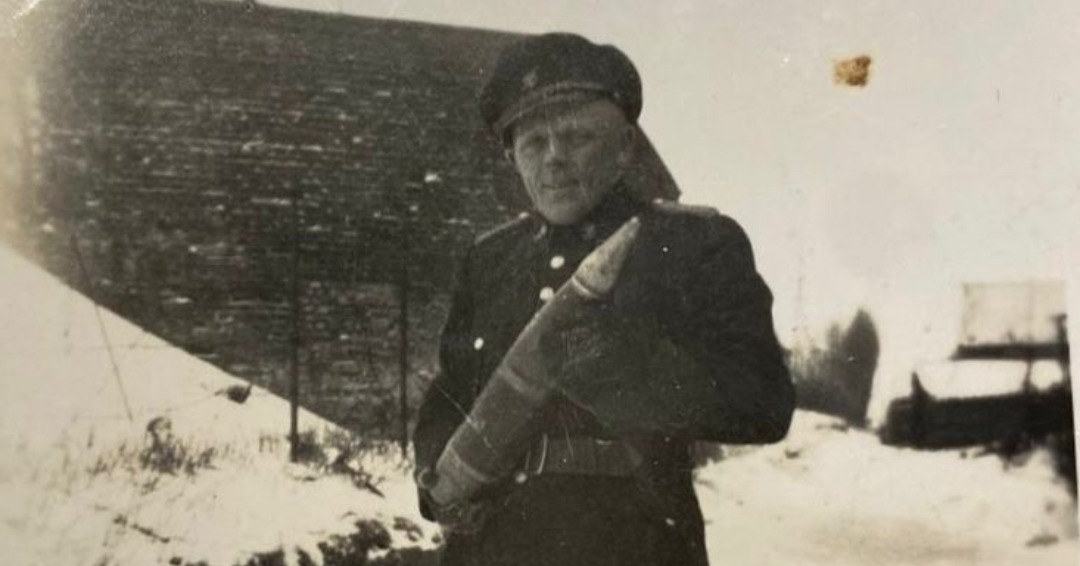
Picture: bomb disposal unit “Groep de Knegt.” Fourth from the left Dirk De Gier
The Ticking of Time: The Double Struggle of Dirk de Gier
In the collective memory of the Netherlands, the soldiers of the Grebbeberg and the pilots of the RAF off the second world war are etched in stone. But in the clay of the Rotterdam shipyards, deep beneath the foundations of the Schaardijk and amidst the ruins of the Haagseveer, a different group of men fought a war that never knew an armistice. Among them was Dirk de Gier (1912–1977). To the outside world, he was the son of a respected entrepreneur, but at his core, he was a man who shook hands with death daily—mostly without a uniform, without status, and ultimately, without recognition.
The Legacy of the Name
Dirk grew up in the shadow of his father’s success. Dirk de Gier Sr. was a beacon in Kralingseveer: a grocer, a publisher, and a man of principles and order. But when the May days of 1940 turned the city to ash, the world of the young Dirk changed forever. He did not become a soldier in the trenches, but a civilian specialist for the Air Raid Protection Service (LBD). He became part of the notorious “Groep de Knegt,” led by his father-in-law, Arie de Knegt. Their mission: to defuse the hundreds of unexploded bombs (UXBs) that lay like ticking time bombs beneath the city’s asphalt.
The Handiwork of Death
The work at the Haagseveer headquarters was not for the faint of heart. Dirk was a technician of the nerves. While the city above him struggled to survive under occupation, he sat in deep pits, often alone with the piercing sound of a stethoscope against the cold steel of a 500-pounder. He listened to the clockwork. If it ticked, he was seconds away from oblivion. If it was silent, it could be a “long delay fuse”—a trap designed to explode just as the expert thought the danger had passed.This was not a military action fueled by the adrenaline of a firefight; it was a cold, lonely war of attrition. Every bomb he neutralized saved hundreds of lives but left a scar on his own soul. The adrenaline his body produced then would, decades later, prove to be the engine of his downfall.
The Grey Shadow: Fraud or Resistance?
The war ended in 1945 with cheers, but for Dirk, a second, perhaps more painful struggle began. The post-war “purges” spared no one who had worked under the authority of the occupier, including the men of the Haagseveer. In the archives of the Political Investigation Service (POD) and the Central Archives for Special Jurisdiction (CABR), rumors and accusations surfaced. Embezzlement. Fraud.What had happened? In the chaos of the “Hunger Winter” and the clearing of bombed-out buildings, the line between “safeguarding” and “misappropriating” was razor-thin. There were allegations that goods recovered from the ruins did not reach their rightful owners. But for men like Dirk, the truth was often more complex. Was it fraud, or was it a way to keep resources out of German hands? Was it embezzlement, or an attempt to help his own community at the Schaardijk survive?The mere suspicion was a poison. For a son from a family where honor and integrity were paramount, an investigation by the POD was an existential insult. It was the moral “dud” that exploded in his conscience years after the war had ended. The man who risked his life for the city was now mistrusted by that very same city.
The Road to Delta
In the 1950s and 60s, Rotterdam rebuilt itself, but Dirk de Gier could not shake off the war. The world saw a man trying to keep up, but inside, a storm raged that we would today recognize as PTSD. At the time, there was no language for it. It was dismissed as “nervousness” or a “somber disposition.”His health began to fail—not from old age, but from the chronic stress of the bomb pits and the post-war shame. The man who had never been a soldier displayed every symptom of a shell-shocked veteran from the trenches. His paranoia grew: did people still see him as someone who was “wrong”? Was the fraud accusation ever truly erased?In 1977, he reached the final station: the Delta Hospital in Poortugaal. The walls of the psychiatric institution provided the safety he could no longer find outside. Here, far from the ticking of clocks and the memories of the Haagseveer, his nervous system finally surrendered. He was “spent.” His heart, which had skipped a beat thousands of times in the mud of Kralingseveer, finally stopped ticking.
A Late Rehabilitation
Dirk de Gier died in the anonymity of a patient, but his legacy is that of a tragic hero. He was the man who cleaned up the mess that others had created, only to be rewarded with suspicion and mental isolation. He did not commit fraud against the city; the war committed fraud against him, by robbing him of his health and his honor.Today, as we walk along the Schaardijk or pass the Haagseveer, we hardly realize we are treading on ground made safe by men like Dirk. He was not a soldier, he wore no medals, but he carried the heaviest burden of all: the knowledge that one mistake meant death, and that peace would never truly set him free. I Antonius am very proud that I can tell you that I have married his Grandchild Monica Johanna de Gier who will always remember her great grandpa. Let us always remember the people who Faught for our future, Antonius (Ton) Bakker!