
War has always been dangerous for not only citizens but also journalists. We often think journalists come after the scene, but it is not like that. Their core work is to highlight the issue to the public and the government. However, the Gaza conflict has become one of the deadliest periods for the media in modern history. Since the escalation of violence in October 2023, journalists covering Gaza have faced relentless risks—from airstrikes, artillery fire, and collapsing buildings to displacement and shortages of basic safety equipment. Believe me or not, the death toll rose, and so did questions about who was responsible, whether journalists were targeted, and whether some were linked to militant groups.
This article is deep down the exact cause of death, number, and whether it was Israel who was responsible all the way or the journalist who killed only those who were linked to the terror group.
Journalists Killed in Gaza: Numbers, Responsibility, and the Complex Truth Behind the Deaths
The journalist, without food and sometimes water, ran for public help; however, who will give justice to them? This article examines what is known so far. If I look at the numbers, the circumstances of these deaths, the claims made by Israel, the responses from media watchdogs, and the broader reality journalists face in Gaza today. I know your next question is, ‘How many journalists have been killed in Gaza?‘. After deep research the numbers show unbelievable history. As of December 12, 2025, at least 249 journalists and media workers had died in Gaza.
Therefore, most of the journalists were Palestinian reporters, cameramen, photographers, and fixers working for local outlets or international organisations. Several were well-known journalists who had documented Gaza for years, while others were freelancers trying to report the war as it unfolded around their homes. The number continues to change as investigations progress, and new cases are being verified every day.
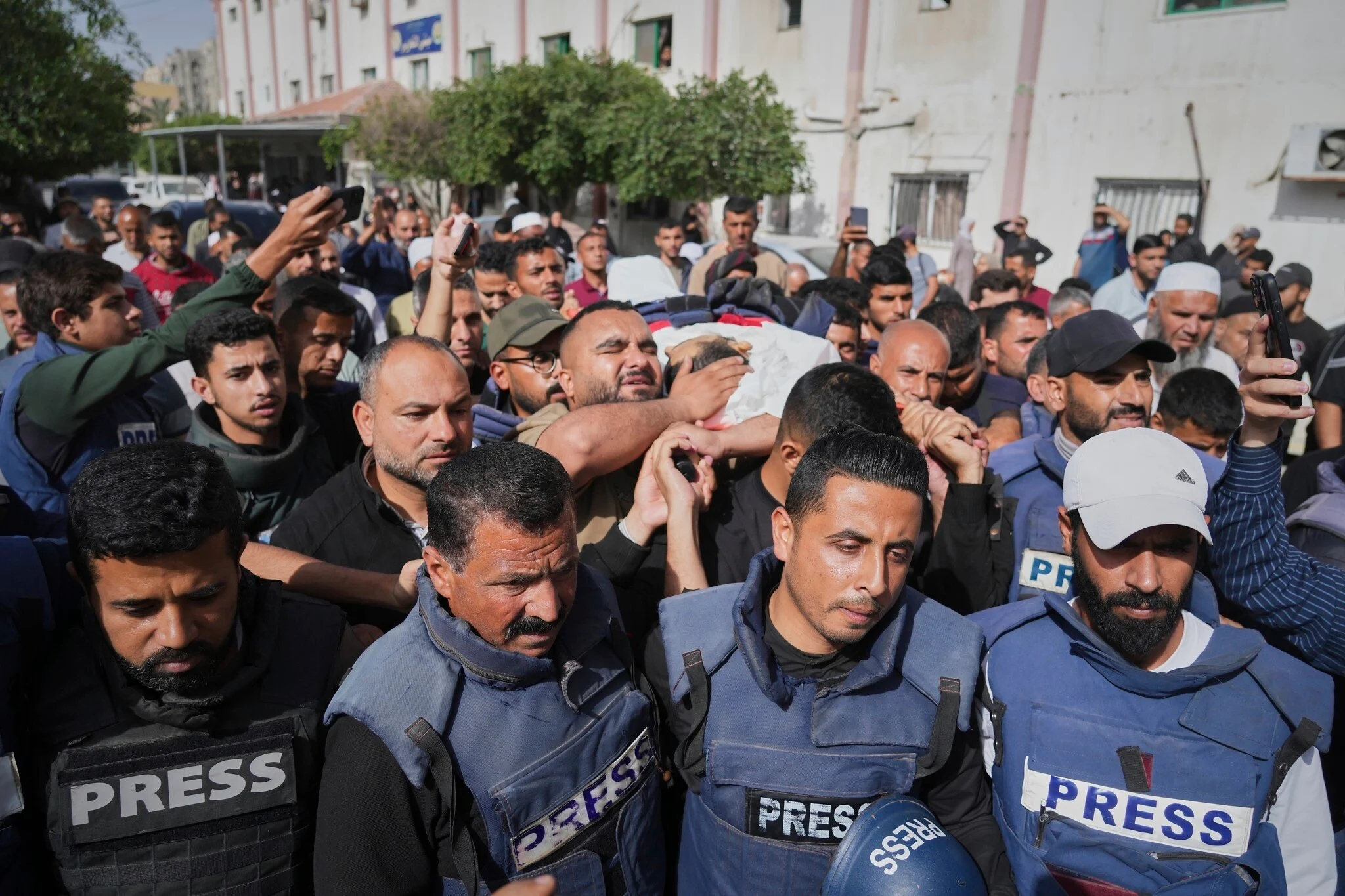
The majority of journalist deaths in Gaza occurred during Israeli airstrikes and artillery attacks, according to independent watchdog groups. Many journalists were killed inside their homes, which also served as workspaces, while others died while reporting in the field. Some of those who were working for local news outlets were killed while wearing press vests, while others were off duty but still recognised locally as journalists. In several cases, entire families were killed along with the journalist, highlighting the scale of destruction in residential areas.
Who Is Considered Responsible?
Israel had acknowledged and held responsible for some deaths. Earlier, Israel used to lie about killing journalists. However, the NYTimes (Israel) stated that journalists were killed unintentionally during military operations targeting Hamas infrastructure. The Israeli military maintains that it does not deliberately target journalists. But this is not true. Press freedom organisations, including CPJ, RSF and FPF, who advocate journalist rights and monitor abuse and provide support, still argue. They mostly talked about the pattern of deaths and the scale of destruction. Also, their studies also find that the lack of independent investigations raises serious concerns. They stress that international humanitarian law requires armed forces to protect civilians, including journalists, even during active combat. So far, no Israeli official has been criminally charged for the killing of journalists in Gaza.
No evidence of any link of the journalist to terror organisations yet?
This question has become one of the most controversial parts of the debate. Israel claimed “Gaza-based journalists killed since the outbreak of the current war were operatives in, or closely affiliated with, terrorist organisations – primarily Hamas and Palestinian Islamic Jihad,” often citing social media activity, family connections, or employment with media outlets it considers affiliated with militant groups.
Moreover, these claims resulted in a dispute and were not accepted by the international journalism organisations. CPJ and RSF state that working for a Gaza-based outlet does not automatically imply militant affiliation, especially in a territory where Hamas controls civil institutions. Therefore, to date, no publicly verified evidence has proven that the majority of journalists killed were active or had family associations with the members of armed groups.
The Case of Al Jazeera Journalists
Several journalists killed in Gaza worked for Al Jazeera, one of the region’s most prominent networks. Israel has accused Al Jazeera of bias and alleged security links, claims the network firmly denies. International observers note that Al Jazeera employs journalists across conflict zones worldwide and follows standard editorial practices. The killing of its reporters has drawn strong condemnation from the United Nations and press freedom groups. These cases remain under dispute, with calls for independent international investigations.
Zena Al Tahhan’s report confirms that in journalist Shireen Abu Akleh’s case, “All the witnesses present at the scene of the crime ensure that it was an Israeli sniper that committed the crime in a deliberate way.”
Still today, Gaza is currently one of the most restricted conflict zones in the world. Foreign tourists and journalists are largely barred from entering independently, making verification difficult. Most reporting relies on local journalists, satellite imagery, and remote investigations. This lack of access fuels conflicting narratives and deepens mistrust between governments, media organisations, and the public. Without independent forensic investigations on the ground, many cases remain unresolved. Beyond physical danger, Gaza’s journalists face extreme psychological stress. Many continue reporting while grieving lost family members, displaced from their homes, and lacking basic necessities.
On a daily basis, several journalists have spoken about feeling trapped between professional duty and personal survival. Despite this, many continue working because they believe documenting the war is essential. Do you think this emotional burden is heavy for their family, who lost their loved ones and are rarely acknowledged in political debates?
What International Law Says
Under international humanitarian law, journalists are considered or treated as civilians unless they directly participate in hostilities. Even if a journalist has political views or works for a state-affiliated outlet, they remain protected unless proven otherwise. Legal experts emphasise that allegations of militant ties require clear evidence, not assumptions or guilt by association. So it is very clear that no international court has ruled that journalists killed in Gaza lost their civilian status.
The deaths have triggered condemnation from the United Nations, UNESCO, Human Rights Watch, and dozens of media organisations worldwide. Several countries have called for accountability and protection of journalists. At the same time, geopolitical divisions have limited concrete action. No international inquiry with enforcement power has yet been launched.
As a result, victims of the journalists’ families continue to wait for justice. The killing of journalists in Gaza is not just a local issue; this has become an international case. It sets a dangerous precedent for war reporting worldwide. If journalists are labelled as militants without transparent evidence, it really undermines press freedom everywhere. It also discourages coverage from conflict zones, leaving the world less informed.
History shows that when journalism is silenced, misinformation fills the gap. What we know is incomplete, contested, and emotionally charged. Journalists in Gaza have died in unprecedented numbers, mostly during Israeli military operations. Claims of militant links exist but remain largely unproven. Independent investigations are limited, and accountability is absent.