
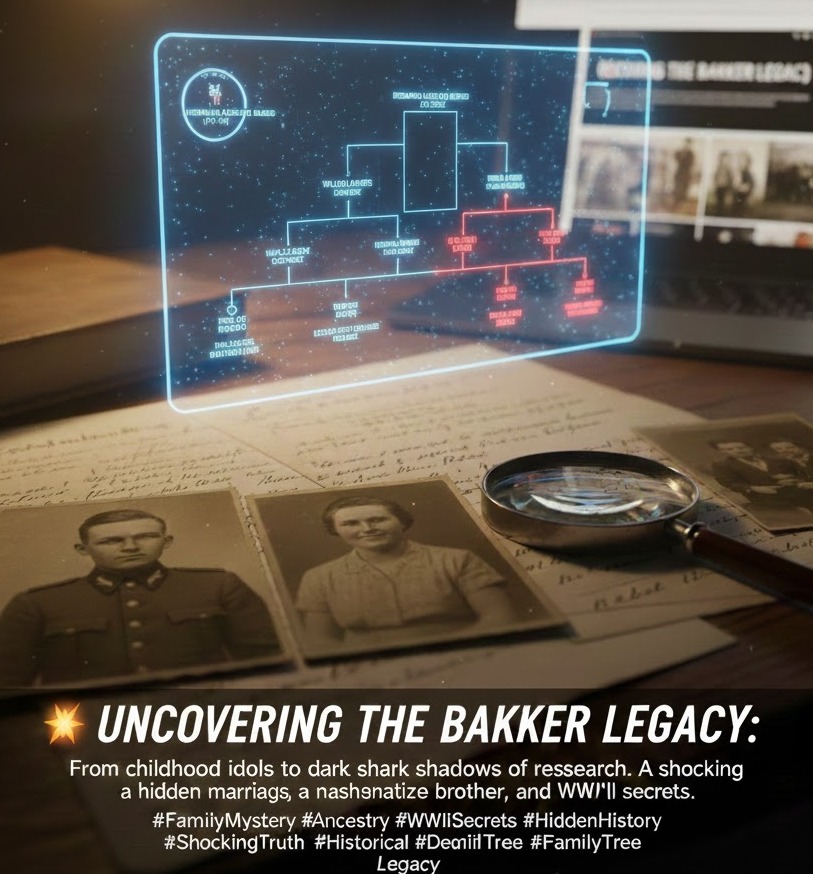
Uncovering the Bakker Legacy: From childhood idols to the dark shadows of genealogical research. I decoded the stoic silence of Hermanus Albertus Bakker (1917-1992) only to find a shocking family glitch: a hidden marriage and a namesake brother tied to Nazi collaboration. As the family tree expanded with Willem Bakker, the quest for authenticity revealed a complex, untold history.
Hero worship, I think we all do it in certain periods of our lives. Just think of the fairytale characters from our childhood, or the musicians, pop stars or film actors and actresses from our youth. Like me, you probably had many posters hanging above your bed in those childhood years of people or figures who were completely unattainable for you and me in our normal lives. Maybe you admired a friend or a distant uncle, but they often wanted absolutely nothing to do with it. Still others among us had or received deep respect for their parents, brothers or sisters in our youth.
From Icons to Influence: The Evolution of Our Heroes

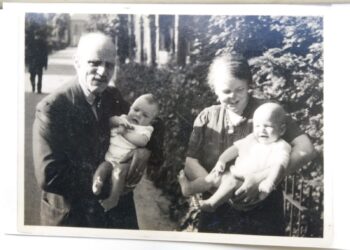
Picture: Johanna Bakker Neervoort-Hermanus Albertus bakker & Grandma Bakker Houtzeel
Is it always possible for us to see the right things? Can we people appreciate their value at the right time? Yes, we often look up to our brothers or our father because they are bigger, or ride a motorcycle or a car, maybe they play at a sports club where they are seen as a hero by others, and we are proud to be their child or brother or sister. But there are also things that we or at least I at a younger age do not see at the right time, or cannot yet assess their value or content. We often find those things difficult. For example, I had a father who withdrew very much into himself. My father didn’t talk much, and had no friends. My father (parents) value family very much, they did a lot to keep them around them
Radical Perspective: Seeing the Unseen Value
As a child, I often didn’t understand that. I saw it as sliming. There was a lot of gossip in the family which I often didn’t understand. How can you gossip about someone and then see him or her as a good friend? It was only much later in my life, when I started doing genealogical research, that I started to understand something of it, I could see the behavior of my parents in a different light and suddenly saw clearly what great hero my father (parents) actually was.Hermanus Albertus Bakker (1917-1992) & Johanna Bakker Neervoort (1916-1981)> I was never able to tell them this in life, they both died much too early. It started, as I wrote before, with the genealogical research, where I suddenly found out that my grandfather (Willem Bakker 1874-1948) had been married not once but three times. With the following partners: Alida Wassenaar, Barbara Joanna Killesteijn and finally with Cornelia Maria van Eijk. The latter eventually became my grandmother.
Rewriting the Narrative: When History Hits Home
When you start genealogical research, I think you always have certain expectations in advance, so do I. Before I started, I thought that my grandfather Willem Bakker had been married twice, and I knew that he had been a horse saddler. So one of the ladies he had been married to came as a surprise to me. Yes, I had once heard in the corridors that there were “illegitimate” children in my grandfather’s family, but how? I also knew in advance that one of the children from my grandfather and grandmother’s family had been wrong in the Second World War, he would have collaborated with the Nazis.What I really didn’t know was that this was a child from my grandfather’s first marriage, with the name: “Hermanus Albertus Bakker.” So this child had exactly the same first and last names as my father!! So there were two children with exactly the same name in my grandfather’s family. One was a Nazi sympathizer, and the other one (my father) a hard-working father with eight children. You can perhaps imagine the confusions this leads to in a small village like Velp (gem. Rheden) must have led?
Which Hermanus Albertus had been bad in the Second World War?
You are beginning to understand what observation this must have led to in the living environment of my father and mother? But this is not all, when the Second World War progressed and the Nazis had too few workers to keep their war machine going, hundreds of thousands of Dutch people were put to work in Germany. This forced Laboure is called Arbeitseinsatz. My father also received a call-up and went to Germany, because refusal was punishable by death. My father was lucky (or the Guts) to be able to flee from this situation, he went into hiding with a few others on a farm in Eibergen (Hupsel), but “strange” things happened here too, there is a story going around that the Nazis suspected that there were people in hiding on “Hupsel”. On a certain day, the Germans placed a machine gun in front of the haystack that was seen as a hiding place and emptied the magazines. Fortunately, the people in hiding, including my father, were in a different place on the estate, and not in their “normal” place, an open hollow in the haystack.
Did freedom become the real torment after the Second World War?
When my father thought to return to his home in Velp after the Second World War as a “free” man with his wife and his first three children, he soon found out that one of his own children was mentally handicapped, the child always remained in his head for ten years, so he never got “older”. (He was aged 80) But there were even more surprises. The people who were put to work by the Germans in Germany had to prove to the civil service and the citizens that they had not worked voluntarily for the Germans when they returned home, they were looked down on by the bourgeoisie for a long time. Another surprise was the fact that his “brother” with the same name had also come to live in the same village of Velp. They were changed almost continuously by the inhabitants and the civil service. This of course led to very unpleasant situations!!
Has the drop ever broken the camel’s back?
So, in retrospect, it doesn’t seem like a pleasant life to me that my parents had. Only now do I understand why my father was sometimes so unreasonable in my eyes, and why he almost always moved in the background. Was it getting too much for him? Yes, I know stories that my father was severely depressed and was one of the first in his time to almost undergo a medical electroshock, my mother spent some time in a nursing home, and to make matters worse, also had a stillborn child. (My sister). After that, I was born as an offspring. Can you imagine that I have often felt out of place? Can you imagine that I would like to know my sister? Because when my mother was discharged from the nursing home, she received the explicit advice of the Pastor and the doctors to have another child, that is me!! In other words, if my sister “Carla” had lived, I would never have been here.
Is this what the church means by penance?
How much misery can a person endure in his life? How much can we handle? Are our true heroes recognized enough? According to the churches, you should never take your own life. But take an example from the people (my parents) that the story above is about. My parents were devout Protestant believers, they always went to church devoutly during their lives, they did not do birth control, but got this life! I also found out through my research that my parents changed churches during their lives. There was an incident in which my father was involved again. My father had a number of sisters with whom he walked to church on Sundays. A number of other (random) Velper churchgoers saw this, but did not know that he was walking arm in arm with his sisters. Suddenly there were whispers that he was cheating. I later read a lot about the history and customs of certain faiths, and read what Luther and Calvin thought about how these believers should behave, I can now say in retrospect that my father could no longer carry the torch of his faith, his mental strength had already disappeared due to constantly having to fight against the advantages that we humans apparently should have.
My mother remained a true Protestant despite the horrors she must have gone through. I can hope that they are now seen as who they really are, my parents Hermanus Albertus Bakker and Johanna Bakker Neervoort.