

The Shadow of the Soldier
This family chronicle traces the Bakker-Neervoort lineage from a mysterious Brussels soldier, Jean Louis Albert, to the Rozenhagelaan in Velp. Highlights include Willem Bakker’s Amsterdam roots, Willem Neervoort’s physical resilience as a Doesburg galvanizing plant worker, and their Dalfsen origins. It celebrates a legacy of resilience, manual labor, and the IJssel river crossings that shaped their history.The history of the Bakker family does not begin in the woods of Velp, but in the turbulent streets of 19th-century Brussels. It was there that the patriarch, Jean Louis Albert, lived. As a soldier during a time of great political upheaval, he moved northward. The story of Jean Louis is shrouded in a mist of mystery that still echoes within the family today. While official Amsterdam records state that he passed away at a young age in 1829, oral tradition tells a different story.

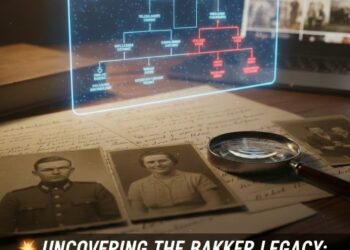
Picture: Granpa and Grandmother Bakker
For decades, a legend persisted within the family that the soldier had not died, but had simply vanished. It was whispered that, driven by the unrest of the Belgian Revolution of 1830, he abandoned his post and his family to build a new life elsewhere under a different name. This “vanished soldier” left his children behind in a city they could not truly call their own. His son eventually adopted his mother’s surname: Bakker. In doing so, the name “Albert” became a middle name—an echo of a Brussels past that slowly faded but never truly disappeared.
The Amsterdam Years of Willem Bakker
The Bakker name was firmly established by Willem Bakker, born in 1874. Willem knew the hardships of Amsterdam city life firsthand. His life was one of trial and error. His first marriage to Alida Wassenaar ended tragically with her early death in 1902, leaving Willem to care for young children alone. A second marriage to Barbara Johanna Killesteijn did not last and ended in divorce in 1914—a rarity and often a social stigma in those days.
Willem sought stability and finally found it with Cornelia Maria van Eijk. Around 1920, he made a life-changing decision: he left the bustle of Amsterdam behind and moved east, to the stately avenues of Velp. On the Rozenhagelaan, he opened a new chapter. He became a well-known figure there, a man who combined Amsterdam’s directness with Gelderland’s tranquility. In this household, your father, Hermanus Albertus, grew up. It was also here that David Guillaume was born—the uncle you know as Adriaan. The choice of his official names was a final tribute to the mysterious soldier from Brussels, but in daily life, he was named after his mother’s father: Adrianus van Eijk.
The Call of the Vecht: The Neervoort Branch
While the Bakkers found their way to Velp, the origins of the other side of the family lay in the watery north. The name Neervoort takes us back to Dalfsen on the river Vecht. The name itself is a relic from a time when rivers were natural barriers; a “neer-voort” (lower ford) was a shallow, traversable spot in the water. Your mother’s ancestors were people of the land and the water.
In the 19th century, this family followed the course of the river IJssel south to Doesburg. It was here that Willem Neervoort was born in 1881, the son of Harmannus Neervoort and Harmina Pieper. Where the Bakkers were mobile and at times restless, Willem Neervoort was the personification of steadfastness and physical strength.
Willem Neervoort: A Character of Steel and Zinc
Willem Neervoort was a man who never shied away from hard labor. In the early part of his working life in Doesburg, he worked in a galvanizing plant (verzinkerij). This was grueling and hazardous work in the metal industry, where iron objects were submerged in glowing, molten zinc to protect them from rust. It required an iron constitution to endure the heat and fumes of the factory for years.
Later in life, he continued his career as a day laborer (loonarbeider). He was a man who took on work wherever it was available—a true “get-to-work” mentality typical of the Doesburg working class of that era. Despite this physically demanding life, Willem remained remarkably vital. On the Bergstraat, where the family lived, he was a respected figure. When his daughter Johanna was born in 1916, he provided her with a secure home. The fact that Willem ultimately reached the age of 92—a rarity for someone who had performed such heavy manual labor—testifies to his enormous life force. When he passed away in Doetinchem in 1973, a man who had literally and figuratively laid the foundation of the modern family was gone.
The Merging at the Rozenhagelaan
The meeting of Hermanus Albertus Bakker and Johanna Neervoort was the merging of two powerful traditions. Herman brought with him the history of the Amsterdam orphans and the French flair of the name Albert. Johanna brought the pragmatism and work ethic of the Doesburg Neervoorts.
They settled in Velp, the place chosen by Willem Bakker. Here, between the river IJssel and the hills of the Veluwezoom, a new generation grew up. The names of the ancestors were passed down through the stories told at the dinner table. Uncle Adriaan remained the most beautiful example of this family history: “David Guillaume” on his identity card as a tribute to the soldier, but “Adriaan” in the hearts of the family as a tribute to their Gelderland roots.
A Legacy of Resilience
Looking back, we see a pattern of immense resilience. From the mysterious soldier in Brussels to the man who earned his bread in the galvanizing plant of Doesburg: these are stories of survival and starting over. The Bakker-Neervoort family is a family of the river. The name Neervoort reminds us of the safe crossing, and the great age of Willem Neervoort reminds us of the strength to endure. They forged their path through history, from the factory floor to the Rozenhagelaan, leaving behind a foundation of down-to-earth practicality and indestructible vitality. I am very proud tob e born from this family – Antonius (Ton) Bakker