

OpenAI has unveiled GPT-5.2, a release the company is calling the smartest publicly available AI model in the world. And because the rollout begins with Plus, Pro, Business, and Enterprise users—with free-tier access and an API release soon—its capabilities are already sparking intense debate across the tech ecosystem. The model arrives in three specialized versions. Instant for fast and lightweight tasks, Thinking for long-form reasoning, and Pro for advanced problem-solving that blurs the line between assistant and expert collaborator.
OpenAI Releases GPT-5.2 as World’s Smartest Public AI Model
Moreover, GPT-5.2’s early benchmarks reinforce that claim of superiority, as it posted stunning results across academic and professional tests. It scored 55.6% on SWE-Bench Pro, placing it far ahead of earlier models in real-world coding tasks. Additionally, it achieved 92.4% on GPQA, a notoriously tough science reasoning exam, and hit a flawless 100% on AIME 2025, the elite mathematics assessment used for Olympiad qualification. Because of these leaps, OpenAI says GPT-5.2 matches or surpasses human performance 70.9% of the time across 44 evaluated knowledge-work jobs, suggesting a shift toward AI models capable of domain-specific expertise rather than generic assistance.

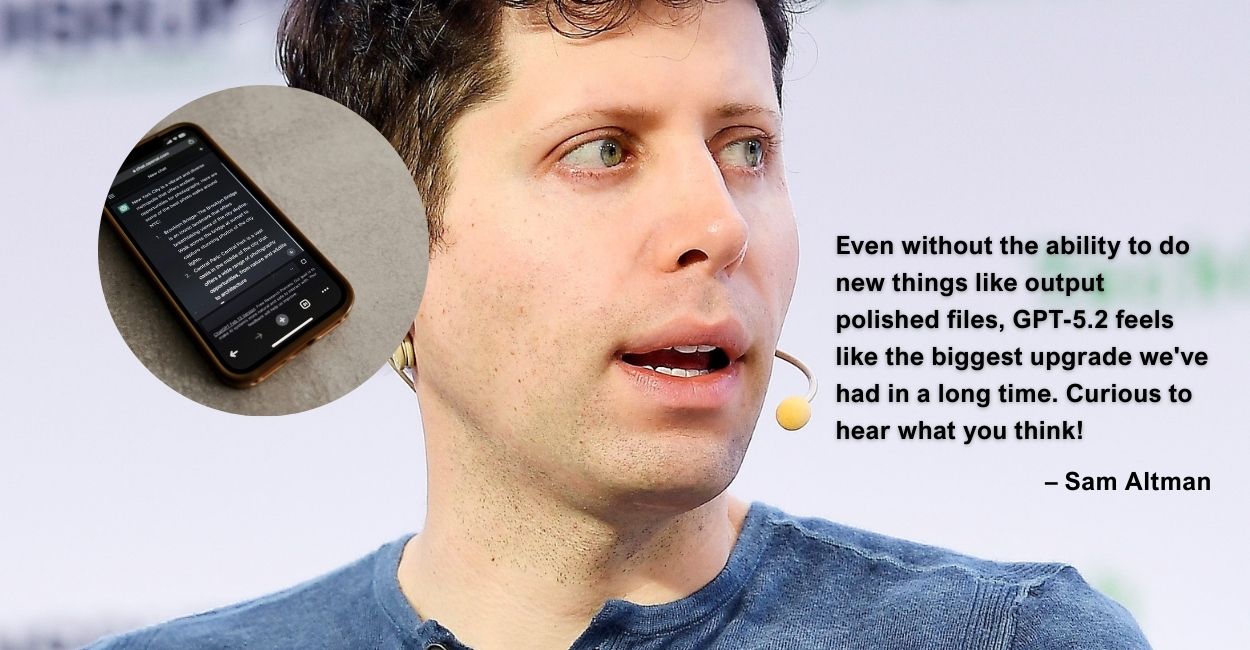
Furthermore, industry leaders have taken note, with OpenAI CEO Sam Altman and Microsoft’s Satya Nadella both highlighting the model’s surge in reasoning, planning, and tool-building. Their praise underscores how GPT-5.2 moves closer to what enterprises have long demanded—an AI that not only provides answers but also constructs solutions, synthesizes workflows, and audits its own reasoning. The three-tiered design is central to this shift: Instant handles chats and summaries, Thinking attempts dense logic chains, and Pro tackles the kinds of structured challenges that once required teams of specialists.
Nevertheless, the rollout has not been without friction, as some developers report latency spikes and more verbose outputs, especially in the thinking mode. And while OpenAI has already acknowledged these concerns—promising speed and usability improvements in the coming updates—the feedback illustrates the ongoing tension between depth and efficiency in next-generation AI systems. The more a model “thinks”, the more computational overhead it naturally carries.
Taken together, GPT-5.2 marks a pivotal moment for consumer and enterprise AI, pushing public models into territory once reserved for proprietary research systems. It signals OpenAI’s ambition to dominate the expert-AI landscape while revealing the growing pains that accompany cutting-edge capability. As fixes roll out and access expands, GPT-5.2 is poised to alter workflows, education, programming, and scientific exploration—setting a new baseline for what everyday users can expect from artificial intelligence.