
FOR THE SAKE OF VICIOUS ENDING EXPLAINED: Decode the brutal finale. We dissect the fate of Romina and Chris and analyse how the film ruthlessly proves that the cycle of violence is impossible to escape.
For the Sake of Vicious Ending Explained: The Brutal, Unbroken Cycle of Retribution
The Haunting Epilogue of a Blood-Soaked Halloween
For the Sake of Vicious is not a whodunit; it’s a whydunit stripped bare, a raw, uncompromising plunge into the infectious nature of retribution. Directors Gabriel Carrer and Reese Eveneshen crafted a film that functions less as a traditional narrative and more as a pressure gauge for escalating human savagery. By the time the final moments arrive, the audience aren’t seeking a victory; they are simply begging for the brutal cacophony to cease.
The film’s thesis is simple, terrifying, and ultimately confirmed by its conclusion: vengeance is a plague, and once released, it consumes everyone in its path, leaving no moral sanctuary intact.
The Setting: A Stage for Extinction
The entire Halloween night unfolds within the claustrophobic confines of Romina’s (Lora Burke) house, a choice that magnifies the trauma. This seemingly safe domestic space becomes a cage, then a battlefield, and finally, a mortuary.
The setup is a Gordian knot of pain
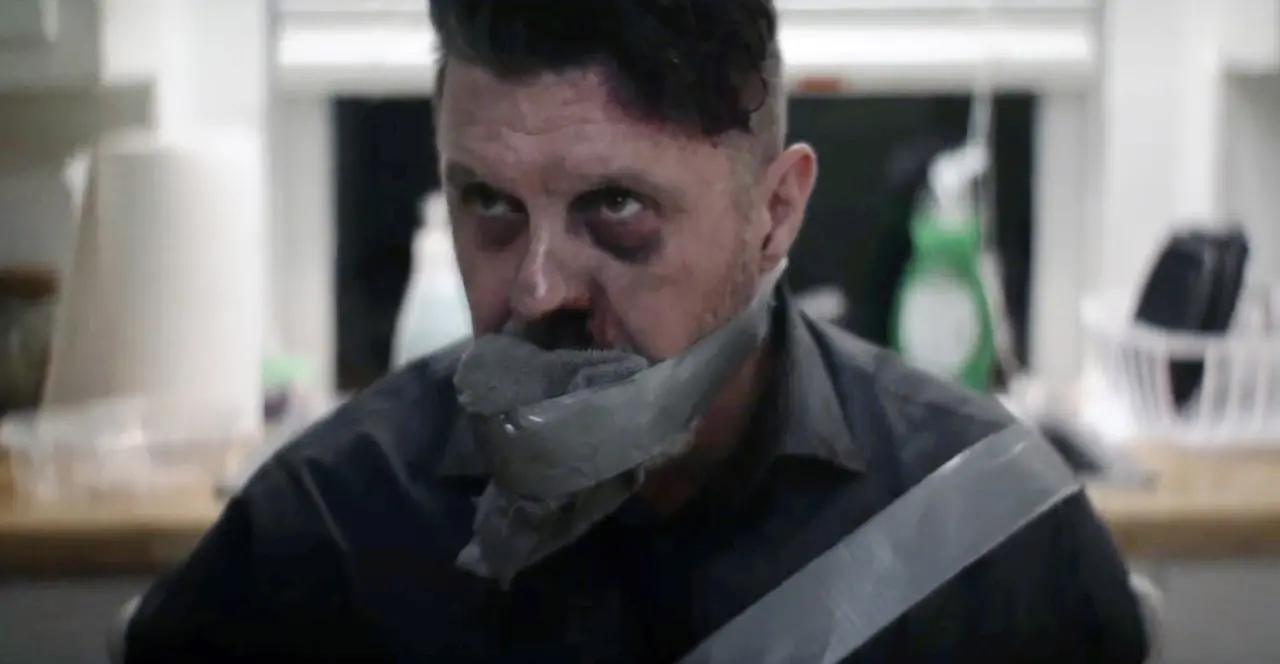
Chris (Nick Smyth): The grieving father, a man driven mad by the assault and subsequent death of his daughter, Charlotte, five years prior.He has kidnapped
Alan (Colin Paradine)—Romina’s landlord—who he believes is the culprit.His motivation is singular: a confession, or justice, however ill-defined.
Romina: The overworked nurse and single mother, initially the innocent bystander.Her only direct connection is having treated Chris’s daughter years ago.
She is trapped between her professional imperative to save Alan and Chris’s furious demand for a reckoning.
The Intrusion: Alan, who is far more than a simple landlord, calls on his shadowy associates—a merciless biker/gang crew led by the quiet but terrifying Gerald (James Fler). They arrive not as rescuers but as a cleansing fire, intent on eliminating all witnesses and securing Alan’s dark interests.
The True Revelation: The Crime Against Self
As the masked invaders breach the home, the initial, tense drama—the question of Alan’s guilt—recedes. The second half of the film is pure, unrelenting action, a crimson ballet of stabbings, hammer blows, and guttural screams that has been likened to the visceral fury of films like The Raid or the most intense sequences of Mandy.
The true tragedy emerges in the chaos:
- The Motive Was Secondary: The invaders don’t care about Chris’s grief or Alan’s alleged crime. They are there to mop up a loose end. Alan, in his desperation, signed his own death warrant by calling them. They are vicious because that is their nature, and their purpose is to perpetuate the cycle of silence and elimination.
- The Romina Transformation: Lora Burke’s performance is the anchor of the film. Romina begins the night trying to mediate, tending to Alan’s wounds even as Chris threatens them both. By the end, she is a warrior of necessity. She weaponizes household objects and, in the final, exhausting confrontation, kills not with rage, but with a cold, desperate pragmatism. She survives, but the caring nurse is gone, replaced by a traumatized shell forged in bloodshed.
- Chris’s Hollow End: Chris, having spent five years focused on Alan, dies from his wounds. His quest for justice is rendered meaningless, not by Alan’s innocence (which remains ambiguous, though Alan is clearly a monster), but by the sheer, overwhelming power of the system of violence he accidentally triggered. His vengeance was a flicker; the response was an inferno.
The Unbroken Circle: The Final Scene
The film’s final moments are deliberately ambiguous, yet devastatingly clear. Romina is the sole survivor, covered in blood, sitting in the ruined house amidst the corpses of Chris, Alan, and the masked attackers.
- The Landlord’s Final Apology: Some analyses focus on the brief shot of a picture or a piece of Romina’s son’s artwork. This detail, often overlooked in the gore, connects Romina’s survival back to her identity as a mother. She fought for her life and, implicitly, for her son’s future. However, there is also the chilling possibility, noted by fans on Reddit discussion threads and YouTube explanations (like the detailed breakdowns provided by channels such as Dead Meat or similar horror analysts), that Romina’s landlord, Alan, was more connected to her than just a business associate, perhaps even the father of her child, though this remains an intentional ambiguity. This possible, final secret only deepens the terror of Romina’s profound violation.
- The Empty Room: Romina is left alone in the wreckage. Her survival is not a victory for the “final girl” trope; it’s a stark, traumatic ending for a character who has been forced to become vicious to escape. She hasn’t escaped the nightmare; she has internalised it. The violence ends not because justice was served, but because the supply of victims ran out.
- The Lingering Questions: The film refuses to offer the tidy answers of a courtroom drama. We never definitively know Alan’s role in Charlotte’s death or precisely what crime he committed to warrant the arrival of Gerald’s gang. But the ambiguity is the point: the precise details of the initial injustice no longer matter. All that remains is the consequence—the overwhelming, self-sustaining force of the viciousness itself. Romina is now the custodian of this brutal legacy, a survivor who must carry the weight of this night into every subsequent day.
For the Sake of Vicious concludes not with a hopeful sunrise but with the haunting quiet after the storm, proving that true horror lies not in the monster’s arrival but in the sickening realisation that to survive the darkness, you must let a little of it into your own soul. Did you watch Kantara Chapter 1? Know South Indian films that have broken the records of many Bollywood films – ending explained. Also know what had happened in Squid Game Season 3, Ending Explained too.